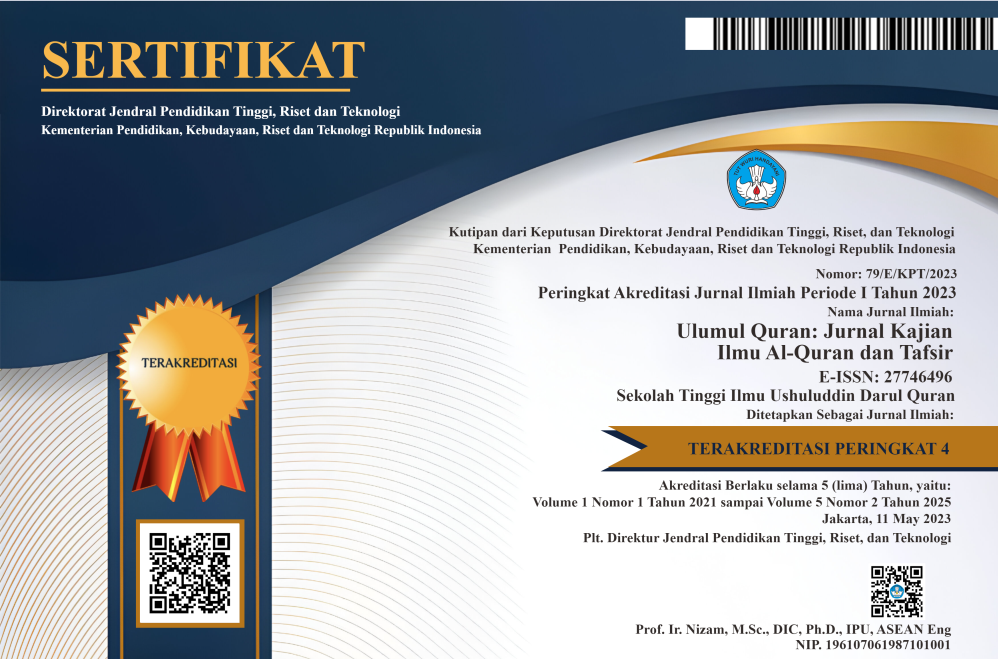
Author Guidelines
Shortcuts
3. Manuscript Submission Overview
5. Preparing Figures, Schemes and Tables
6. Supplementary Materials and Data Deposit
1. General Author Guidelines
- The manuscript should be written in Indonesian or English, have never been published, or is not in the process of submission for publication to other media. It should not contain elements of plagiarism.
- The manuscript may take the form of research, case studies, or literary studies.
- The author should register as an author in our Open Journal System (OJS). The guide to register and submit the paper is provided in the system.
- The length of the manuscript is between 5,000 - 12,000 words excluding abstract and references.
- The manuscript will be published in Jurnal Ulumul Qur'an: Jurnal Kajian Ilmu Al-Qur’an dan Tafsir after being reviewed by peer reviewers.
- The manuscript should be prepared according to the author's guidelines and Template. The writing template can be downloaded here.
2. Submission Checklist
Before submitting, please ensure the following:
- Read the Focus and Scope to gain an overview and assess if your manuscript is suitable for this journal.
- Use the Microsoft Word template to prepare your manuscript.
- Make sure that issues about publication ethics, copyright, authorship, figure formats, data, and references format have been appropriately considered.
- Ensure that all authors have approved the content of the submitted manuscript.
- Authors are encouraged to add a brief biography (optional) to the submission and publish it.
3. Manuscript Submission Overview
Types of Publications
Jurnal Ulumul Qur'an: Jurnal Kajian Ilmu Al-Qur’an dan Tafsir has restrictions on the length of manuscripts (5,000 – 12,000 words), provided that the text is concise and comprehensive. Full experimental details or literature analyses must be provided so that the results can be reproduced or verified.
The journal exclusively publishes original articles. We do not accept other types of manuscripts, such as Book Reviews, Review Essays, etc. The journal considers all original articles provided that the work reports scholarly sound analyses, provides a substantial amount of new insights, and emphasizes the study of al-Qur'an and Tafsir. Authors should not unnecessarily divide their work into several related manuscripts. Manuscripts submitted should neither be published previously nor be under consideration for publication in another journal.
Submission Process
Manuscripts should be submitted online at our Open Journal System. The submitting author (generally the corresponding author) is responsible for the manuscript during the submission and peer-review process. The submitting author must ensure that all eligible co-authors have been included in the author list and that they have all read and approved the submitted version. The Corresponding author can track the manuscript details in the submission system.
Accepted File Formats
- Microsoft Word: Manuscripts must be converted into a single Word file before submission using the official journal template. Please insert your graphics (schemes, figures, etc.) in the main text after the paragraph of its first citation. All text and metadata identifying the authors should be removed before submission for blind review.
- Supplementary files: May be any format, but it is recommended that you use common, non-proprietary formats where possible.
Format Submission
- While we accept initial free-format submissions, all manuscripts must eventually contain the required sections: Author Information, Abstract, Keywords, Introduction, Methods, Results, Discussion, Conclusions, Figures/Tables with Captions, Funding Information, Author Contributions, Conflict of Interest, and other Ethics Statements.
- Your references must use the Chicago Manual of Style 17th edition (full note, no ibid) / Turabian 8th style (full-note). It is essential to use a Reference Manager Application like Mendeley, Zotero, or EndNote to make formatting consistent. Referral sources should comprise at least 80% journal articles, proceedings, or research results from the last ten years. DOI numbers are highly encouraged.
Cover Letter
A cover letter must be included with each manuscript submission. It should contain the full author names, affiliations, and title. It should briefly explain why the content of the paper is significant and fits the scope of the journal. Confirm that neither the manuscript nor any parts of its content are currently under consideration or published elsewhere.
Author Biography
Authors are encouraged to add a short biography (maximum 100 words). This should be a single paragraph containing: 1) Authors’ full names followed by current positions; 2) Current and previous research interests.
4. Manuscript Preparation
General Considerations
Research manuscripts should comprise:
- Front matter: Title, Author list, Affiliations, Abstract, Keywords.
- Research manuscript sections: Introduction, Results and Discussion, Conclusions.
- Back matter: Supplementary Materials, Acknowledgments, Author Contributions, Conflicts of Interest, AI Declaration, References.
Transliteration: The Arabic transliteration system must be used consistently throughout, except for quotations using original symbols. Please check our official transliteration system.
Front Matter
- Title: Short, bright, and informative (does not exceed 12 words). It must pinpoint the issues discussed without uncommon abbreviations.
- Author List and Affiliations: Author's name, institution, institution address, and email address, without academic or job titles. At least one corresponding author must be designated.
- Abstract: Written in Indonesian and English, maximum 250 words in one paragraph. It must structurally cover: 1) Background; 2) Methods; 3) Results; 4) Conclusion.
- Keywords: 3-5 phrases pertinent to the article.
Research Manuscript Sections
- Introduction: Contains a general background, literature review (state of the art), main research problems, research method, and the purpose of the study. Describe hypotheses (if any) and highlight controversial and diverging views when necessary.
- Result and Discussion: Consists of research results and interpretation. Results must be supported by sufficient data and answer the research hypothesis/questions. Discuss how results relate to the original objectives, provide scientific interpretations, and compare findings with previous studies.
- Conclusions: Answers the research objectives and discoveries. Do not just repeat the abstract. Suggest future research directions.
Back Matter
- Supplementary Materials: Describe any supplementary material published online (e.g., Figure S1: title, Table S1: title).
- Acknowledgments: Acknowledge administrative/technical support or donations not covered by funding.
- Author Contributions: Specify individual contributions (e.g., "Conceptualization, X.X. and Y.Y.; Methodology, X.X.; Writing – Original Draft Preparation, X.X.", etc.).
- Data Availability Statement (optional): Provide details regarding where data supporting reported results can be found.
- Conflicts of Interest: Declare any personal circumstances or interest that may influence the representation of results. If none, state: "The authors declare no conflict of interest."
- Funding: Include a funding acknowledgement statement. Example: "This work was supported by [Agency Name] [grant number xxx]." If no funding, state: "The author(s) received no financial support for the research, authorship, and/or publication of this article."
- AI Declaration: Authors must disclose substantive use of generative AI or AI-assisted technologies in the writing process. Suggested statement: "During the preparation of this manuscript, the author(s) used [name of tool] for [specific purpose]. The author(s) reviewed, verified, edited, and approved all AI-assisted output and take full responsibility for the accuracy, originality, and final content of the manuscript." AI tools must not be listed as authors.
- References: Arranged alphabetically using Chicago Manual of Style 17th (full-note). Use reference managers like Mendeley. Ensure 80% of sources are from the last 10 years.
5. Preparing Figures, Schemes and Tables
- Files for Figures and Schemes must be provided at a sufficiently high resolution (minimum 300 dpi). Preferred formats: TIFF, JPEG, EPS, and PDF.
- Insert into the main text close to their first citation and number them sequentially (Figure 1, Table 1, etc.).
- All Figures and Tables must have a short explanatory title and caption. Table columns should have explanatory headings. Use the Table option in Microsoft Word to create tables.
6. Supplementary Materials and Data Deposit
Jurnal Ulumul Qur'an encourages authors to share their research data to support open scientific exchange and transparency. We base our data policies on TOP Guidelines (Citation standards, data transparency, replication policies).
Where ethical, legal, or privacy issues are present, data should not be shared. Authors should make limitations clear in the Data Availability Statement. Ensure shared data complies with participant consent.
Suggested Data Availability Statements:
- Publicly accessible repository: "The data presented in this study are openly available at [doi/link]."
- Available on request: "The data presented in this study are available on request from the corresponding author due to [insert reason/privacy]."
- 3rd Party restrictions: "Data were obtained from [third party] and are available with permission."
- Contained within article: "The data presented in this study are available in the supplementary material or reference list."
- Not applicable: "No new data were created or analyzed in this study."
Unpublished Data: Avoid "Data not shown". "Unpublished data" intended for future publication should be cited in the text and references. "Personal Communication" must also be properly cited.