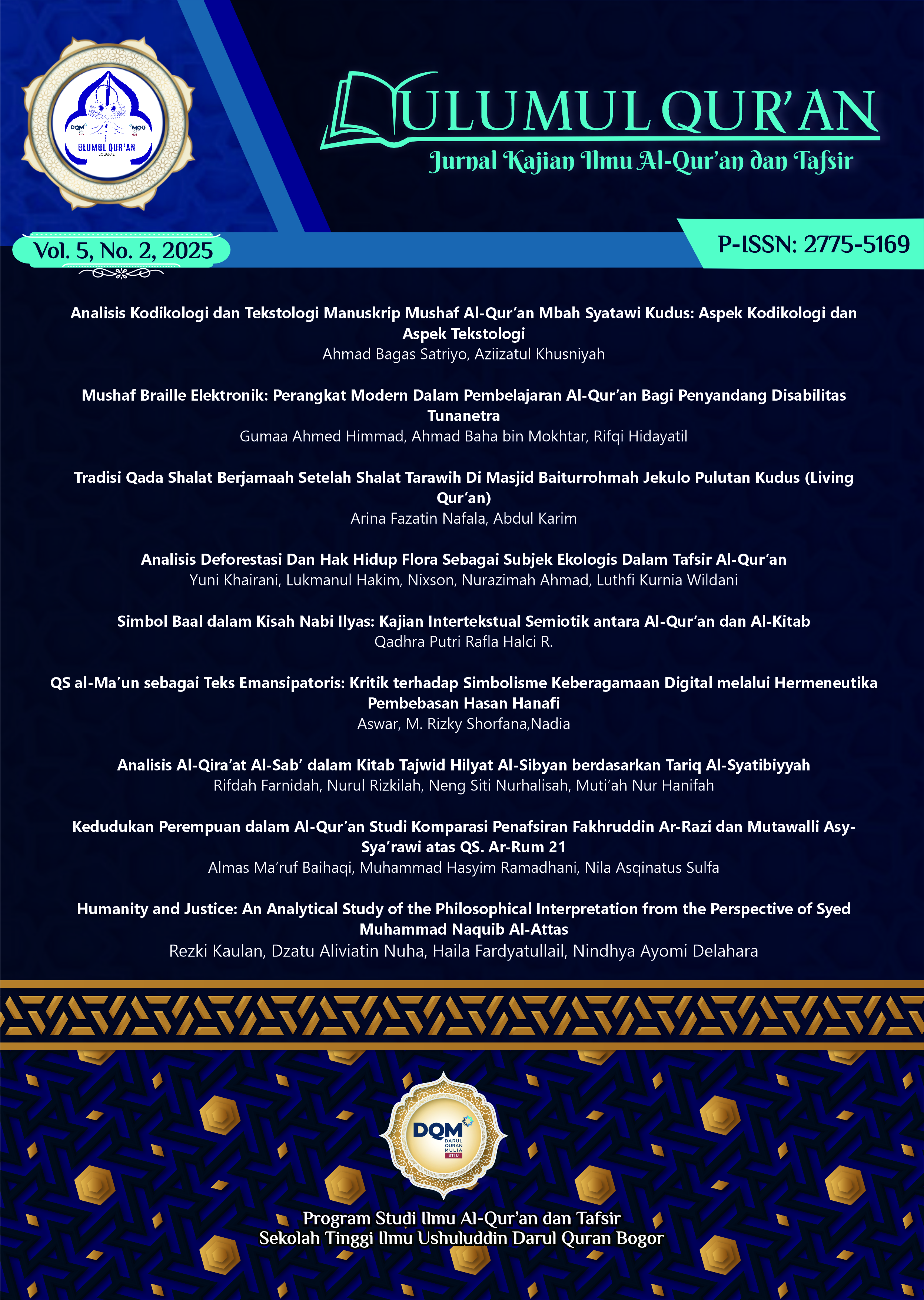
Humanity and Justice: An Analytical Study of the Philosophical Interpretation from the Perspective of Syed Muhammad Naquib Al-Attas
DOI:
https://doi.org/10.58404/uq.v5i2.532Keywords:
Al-Attas, Justice, Humanity, Philosophical InterpretationAbstract
One of the most pressing and multifaceted challenges in contemporary society is the issue of justice in human life. Social inequality, discrimination, and disparities in access to fundamental rights - such as education, economic opportunities, and healthcare - serve as tangible evidence that justice often remains an abstract ideal without equitable implementation. This study examines the concept of humanity and justice in Islam through the interpretive framework of Syed Muhammad Naquib al-Attas, with a focus on: (1) the definition of justice, (2) the individual as the subject of justice, (3) individual freedom as the foundational principle of justice, and (4) equality as a critical prerequisite for justice. Employing a qualitative research design, this study utilizes a descriptive-analytical method combined with a philosophical exegesis approach, interpreting Qur'anic verses through philosophical theory. The findings indicate that humans, as moral agents, play a pivotal role in the realization of justice. Justice, as a core Islamic principle, originates from divine revelation and embodies balance, harmony, and the proper allocation of all things to their rightful place. Justice is achieved when individuals, acting as its practitioners, consciously and freely acknowledge and submit to Allah as the Creator, fulfill their obligations, and equitably honor the dignity of others. Al-Attas underscores the human role as vicegerents (khali>fah) on earth, bearing the responsibility to uphold justice in alignment with human nature (fit}rah). Furthermore, ethics and one’s relationship with God are identified as essential foundations for fostering justice within society and the state.
References
Abdurrahman, U. “Metodologi Tafsir Falsafi Dan Tafsir Sufi.” Adliya’ 9, no. 1 (2015): 252.
Al-Ashfahani. Mu’jam Mufrodat Al-Fadh Al-Qur’an. Dar al-Kitab al-‘Arabi, 1972.
Al-Attas, Syed Muhammad Naquib. Islam and Secularism. Kuala Lumpur: International Institute of Islamic Thought and Civilization (ISTAC), 1993.
———. “Manusia Dan Cita Keadilan.” Majalah Bestari, 1990.
———. On Justice and the Nature of Man. Kuala Lumpur: IBFIM, 2015.
———. Prolegomena to the Metaphysic Al-Islam an Exposition of the Fundamental Elements of the Worldview of Islam. Kuala Lumpur: ISTAC, 1995.
———. Prolegomena to the Metaphysic Al-Islam an Exposition of the Fundamental Elements of the Worldview of Islam. Kuala Lumpur: ISTAC, 1995.
———. Risalah Untuk Kaum Muslimin. Kuala Lumpur, 2001.
———. The Concept of Education in Islam. Kuala Lumpur: Ta’dib International, 2018.
Al-Maududi, Abul A’la. Prinsip-Prinsip Islam Terj. Abdullah Suhaili Principles of Islam. Bandung: PT. Al-Ma’arif, 1991.
Ali, H. A Mukti. Alam Pikiran Modern Di India Dan Pakistan. Bandung: Mizan, 1998.
Ali, Imam. Nahjul Bulagha’: Sermons, Letters and Sayyings of Imam Ali. Qurn: Ansariyan Publications, 1989.
Amin, Mahir. “Konsep Keadilan Dalam Perspektif Filsafat Hukum Islam.” Al-Daulah: Jurnal Hukum Dan Perundangan Islam 4, no. 02 (2015). https://doi.org/10.15642/ad.2014.4.02.322-343.
Bakir, Moh. “Tanggung Jawab Sosial Dalam Al-Qur’an: Studi Analisis Terhadap Term Al-Islah.” Jurnal Kaca: Jurnal Dialogis Ilmu Ushuluddin 11, no. 1 (2021): 6.
Fitriani, Lukman Hakim, and Abu Bakar. “Konsep Mental Block Perspektif Al-Qur’an (Analisis Penafsiran Surah Al-Insyirah Dan Teori Logoterapi Victor E. Frankl).” Ulumul Qur’an: Jurnal Ilmu Al-Qur’an Dan Tafsir 4, no. 2 (2024): 190–206.
Hakim, Muhammad Hanif Al, and Hudzaifah Muhammad Maricar. “On Islamic Concept of Man and Justice in Pancasila.” Tsaqafah 19, no. 2 (2023): 335–52.
Hidayatullah, Amir, and Amir Reza Kusuma. “Pendidikan Jiwa Islami Menurut Syed Muhammad Naquib Al-Attas.” Edunomika 07, no. 02 (2023).
Hidayatullah, Rakhmad Agung, Amir Reza Kusuma, and Jarman Arroisi. “Konsep Manusia Ideal Menurut Syed Muhammad Naquib Al-Attas.” In International Conference and Visiting Scholars, 1–15. Ponorogo: INSURI, 2022.
Intani, Nabilah Putri. “Perang Sampit (Konflik Suku Dayak Dengan Suku Madura) Pada Tahun 2001.” Sosial: Jurnal Penelitian Ilmu-Ilma Sosial, 2022.
Ismail, Ahmad Munawar, Latifah Abdul Majid, and Muhammad Farhan Firas. “Rethingking Justice: Unravelling the Tapestry of Justice in Islamic and Western Philosophics.” Islamiyat 46, no. 1 (2024).
Jesica, Naomi, Meta Nadia, and Lusi Septiyati. “The Realization of Social Justice for the Poor Citizens According to Legal Philosophy.” Fiat Justisia 12, no. 4 (2018).
Khadduri, Majid. Teologi Keadilan Perspektif Islam. Surabaya: Risalah Gusti, 1999.
Latief, Mohamad, Amir Reza Kusuma, Mohammad Muslih, and Rakhmad Agung Hidayatullah. “Problems of the Secular State and Its Impact on Justice.” Ananlisis: Jurnal Studi Keislaman 23, no. 1 (2023): 67–88.
Lewindy, and Alessandro Christian. “Pelanggaran HAM Dalam Konflik Israel Dan Palestina.” Unes Law Review 6, no. 4 (2024).
Mulyadi. “Konsep Manusia Dan Pendidikan Islam Menurut Syed Muhammad Naquib Al-Attas.” Al-Ikhtibar: Jurnal Ilmu Pendidikan 6, no. 1 (2019).
Muslih, Mohammad, Ahmad Faizin Soleh, Martin Putra Perdana, and Ach Fuad Fahmi. “The Problem of Relativism and Its Implication on Contemporary Issue in Islam Based on Al-Attas’s Worldview Theory.” Fikri: Jurnal Kajian, Agama, Sosial, Dan Budaya, 8, no. 1 (2023).
Mutiah, Novia Isro’atul. “Legal Injustice in the Perspective of Pancasila: Various Recent Developments in Indonesia.” Indonesian Journal of Pancasila Dan Global Constitutionalism 2, no. 1 (2023).
Nurcahyati, Abdur Rakhim Hasan, Dudung Abdul Karim, and Nur Muhammad Iskandar. “Rahasia Amtsal Dalam Al-Qur’an (Kajian Etnografi Aktualisasi Manusia Berkualitas Berdasarkan Qs. Ibrahim 24-15).” Al Muhafidz: Jurnal Ilmu Al-Qur’an Dan Tafsir 4, no. 1 (2024): 117–36.
Qutb, Sayyid. Al-‘Adaalah Al-Ijtima’Iyyah Fil Islam. Kairo: Daar As-Syuruq, 1993.
Rahman, M Taufiq. Keadilan Sosial Dalam Pemikiran Barat Dan Islam: Studi Komparatif Atas Pemikiran John Rawls Dan Sayyid Qutb. Bandung: Lembaga Penelitian Sunan Gunung Djati, 2012.
Revanda, Han. “Faisal Basri Kritik Kenaikan PPN 12 Persen: Yang Dirugikan Rakyat Kecil.” Tempo, 2024.
Rohman, Abdul, Amir Reza, and Muhammad Ari Firdausi. “Melacak Makna Worldview: Worldview Barat Dan Islam.” Kanz Philosophia 7, no. 1 (2021): 45–64.
Samsuri, Suriadi. “Hakikat Fitrah Manusia Dalam Islam.” AL-ISHLAH: Jurnal Pendidikan Islam 18, no. 1 (2020).
Sandimula, Nur Shadiq. “De-Westernisasi Konsep Manusia: Menelaah Konsep Syed Naquib Al-Attas Tentang Hakikat Manusia.” Refleksi Jurnal Filsafat Dan Pemikiran Islam 22, no. 2 (2023): 1–35.
Sholihan. Keadilan Sosial Dalam Pemikiran Barat Dan Islam Kontemporer: Kajian Terhadap Pemikiran John Rawis Dan Sayyid Qutb. Semarang: Rasail Media Group, 2014.
Syafieh. “Perkembangan Tafsir Falsafi Dalam Ranah Pemikiran Islam.” Jurnal At-Tibyan 2, no. 2 (2017): 148.
Wanto, Sugeng, and Muhammad Sofian Hidayat. “Islamization of Western Social Contract Theory from the Perspective of Syed Muhammad Naquib Al-Attas.” Jurnal Ushuluddin 31, no. 2 (2023): 220.
Yunianto, Beny, and Tomy Michael. “Keberlakuan Asas Equality Before The Law Bagi Pejabat Pelaksana Kebijakan Covid-19.” Mimbar Keadilan 14, no. 1 (2024).
Zakariyya, Abu al-Hussain Ahmad bin Faris. Mu’jam Maqayis Al-Lughah. Beirut: Dar Ittihad al-‘Arabi, 2002.
Downloads
Published
How to Cite
Issue
Section
License
Copyright (c) 2025 Rezki Kaulan, Dzatu Aliviatin Nuha, Haila Fardyatullail, Nindhya Ayomi Delahara

This work is licensed under a Creative Commons Attribution 4.0 International License.