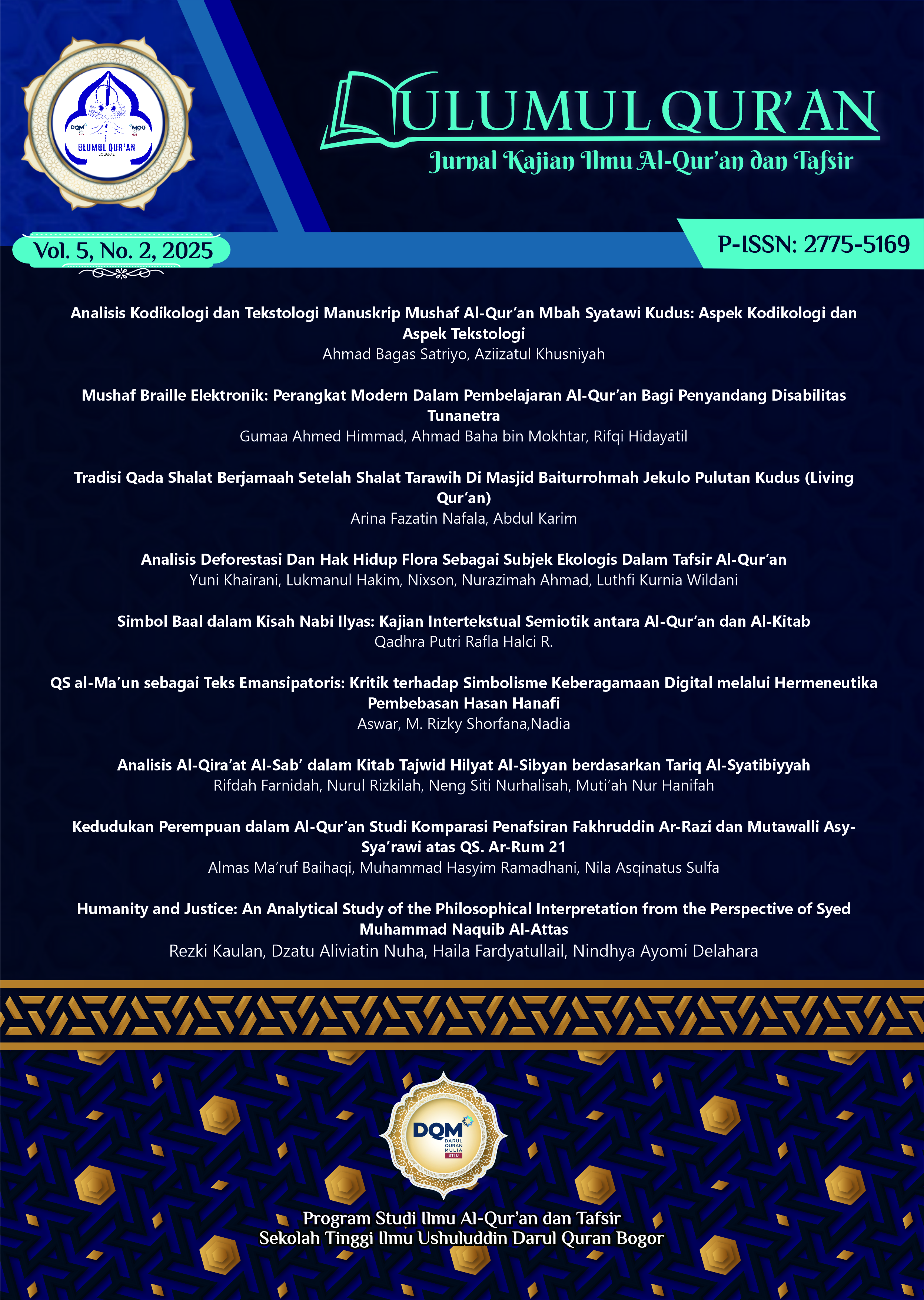
Analisis Kodikologi dan Tekstologi Manuskrip Mushaf Al-Qur’an Mbah Syatawi Kudus: Aspek Kodikologi dan Aspek Tekstologi
Codicological and Textological Analysis of the Mbah Syatawi Kudus Qur'an Manuscript: Codicological and Textological Aspects
DOI:
https://doi.org/10.58404/uq.v5i2.675Abstract
This study examines the codicological and textological aspects of the mushaf Al-Qur’an manuscript of Mbah Syatawi with the aim of understanding its physical characteristics, writing techniques, and the use of rasm, qira`at, scholia, and syakl. This research uses a qualitative approach, using field research methods that focus on collecting primary data through structured interviews with sources directly related to the manuscript, field observations, and digital documentation. The main focus of the research is the manuscript belonging to Mbah Syatawi. The codicological approach is used to analyze the physical aspects of the manuscript such as materials, ink, and illumination, while the textological approach focuses on the writing rules, rasm mushaf (script style), and the qira`at tradition followed. The results show that the manuscript consists of two collections estimated to be over a century old. The inks used are varied, with black ink as the primary color for the Qur’anic text, red ink for scholia and diacritical marks (syakl), and other colors applied to illuminations found on the beginning, middle, and end pages. In terms of writing style, the manuscript employs a mixed rasm combining rasm imla’i and rasm ‘usmani, particularly in the application of rules such as al-Hazf, al-Ziyadah, hamzah, al-Ibdal, and al-Fasl wa al-Wasl. Regarding qira`at, the manuscript follows the qira`at of Imam 'Asim through the transmission line of Imam Hafs. These findings enrich the study of classical mushaf manuscripts in Indonesia, providing significant contributions to preservation efforts, philological studies, and the faithful reproduction of historical manuscripts.
References
Abdullah Saeed. The Quran An Introduction. Routledge, 2008.
Abiyutama, Rafha Adha, Arif Septian Marta, Rafif Weno Putra, Robby Ichsan, Fitria Mayasari, dan Wismanto Wismanto. “Menelusuri Hukum Islam Peran Al Quran Dalam Pembentukan Norma Hukum.” Riset Ilmu Pendidikan Islam 2, no. 1 (2025): 54–58.
Akbar, Ali. “Tracing Individual Styles Islamic Calligraphy from Nusantara.” Jurnal Lektur Keagamaan 5, no. 2 (2007): 245–249.
Alex Sobur. “Bercengkerama Dengan Semiotika.” Mediator 3, no. 1 (2002): 34.
Amroeni Drajat. Ulumul Quran Pengantar Ilmu Ilmu Al Quran. Prenada Media, 2017.
Are, Scholia. Homeric Scholia, 2020, 155.
As Sidiq, Sholihah, dan Aziizatul Khusniyah. “Manuskrip Mushaf Al Quran LSM MJ 014 di Museum Masjid Jami Lasem Analisis Kodikologi dan Tekstologi.” Perada 7, no. 2 (2024): 7–15.
Asrofah. Teks Sastra Sebuah Analisis Keganjilan Dalam Novel. Semarang: UPT Penerbitan Universitas PGRI Semarang Press, 2021.
Azmi, Azwira. “Pentingnya Mushaf dan Rasm Utsmani dalam Pemeliharaan Teks Al Quran.” Kompasiana, 2023.
Churchill, William Algernon. Watermarks in Paper in Holland England France and Other Countries in the Seventeenth and Eighteenth Centuries and Their Interconnection. Brill, 2024.
Elvi Rahmi. “Keefektifan Model Pembelajaran Berbasis Masalah Terhadap Keterampilan Menulis Teks Negosiasi Siswa Kelas Sepuluh SMA Negeri Tiga Maros Kabupaten Maros.” Universitas Negeri Makassar, 2017.
Gerard Genette. Paratexts Thresholds of Interpretation. Vol. 20. Cambridge University Press, 1997.
Habib Fathurraziqin, Juarni Anita. “Penerapan Falsafah Sunda Pada Perancangan Performing Arts Center Melalui Pendekatan Intangible Metaphor Architecture di Kota Baru Parahyangan.” 4, no. 2 (2024): 326–339.
M Fathu El Rahman Awing. “Hamzah Qati dan Hamzah Wasl dalam Surah Al Baqarah Tinjauan Kaidah Imla terhadap Mushaf Madinah dan Mushaf Standar Indonesia.” 2018.
Magfiroh, Baiti Abir, dan Zainal Muttaqin. “Aspek Kodikologi dan Tekstologi Manuskrip Nusantara Studi Kasus Mushaf Al Quran Mbah Ismail.” Canonia Religia 2, no. 1 (2024): 125.
Misnawati, Misnawati. “Kaidah Al Hazf dalam Rasm Utsmani.” Jurnal Ilmiah Al Muashirah 18, no. 1 (2021): 87.
Muhammad Syamlul. Ijaz Rasm Al Quran wa Ijaz Al Tilawah, 31–36. Kairo: Dar Al Salam, 2006.
Nafisah, Mamluatun. “Al Quran Mushaf Manuscript A 648 Collection of the National Library of Indonesia Study of Several Codicological Aspects and Mushaf Texts.” Al Quds Jurnal Studi Alquran dan Hadis 8, no. 3 (2024): 453.
Nasruddin. “Sejarah Penulisan Alquran Kajian Antropologi Budaya.” Rihlah Jurnal Sejarah dan Kebudayaan 2, no. 1 (2015): 57–60.
Nasution, H. “Pelestarian Naskah di Perpustakaan Nasional Republik Indonesia.” Repository UIN Jakarta, 2015, 18–30.
Oman Fathurahman. Filologi Indonesia Teori dan Metode. Jakarta: Kencana, 2015.
Pakhrujain, dan Habibah. “Jejak Sejarah Penulisan Al Quran.” Mushaf Journal Jurnal Ilmu Al Quran dan Hadis 2, no. 3 (2022): 226.
Pujianto, Ahmad Fauzan. “Aspek Qiraat dalam Al Quran.” Salimiya 2, no. 3 (2021): 198.
Rahaja, Hatta. “Huruf Hamzah,” Oktober 2015, 3.
Riddell, Peter G. “Quran Translation Discourse Texture and Exegesis by Hussein Abdul Raof. P 297. Curzon, 2001.” Journal of Quranic Studies 4, no. 1 (2002): 87–90.
Tri Febriandi Amrullah. “Studi Kodikologi Manuskrip Mushaf Al Quran Ibrahim Ghozali.” 2021, 59.
Wehr, Hans. The Hans Wehr Dictionary of Modern Written Arabic. Edited by J Milton Cowan. Journal of the American Oriental Society Dictionary. New York: Hans Wehr’s, 1976.
Zailani. “Metode Intertekstual dalam Memahami Hadis Nabi.” Al Fikri 15, no. 2 (2016): 299.
Zaini, Muhammad, dan Nor Hafizah Bin Mat Jusoh. “Problematika Penulisan Al Quran dengan Rasm Usmani pada Al Quran Cetakan Indonesia dan Malaysia.” Tafse Journal of Quranic Studies 5, no. 1 (2022): 164.
Downloads
Published
How to Cite
Issue
Section
License
Copyright (c) 2025 ahmadbagas satriyo, Aziizatul Khusniyah

This work is licensed under a Creative Commons Attribution 4.0 International License.